Designing Sustainable Microcontrollers
Date:

Image Credit: Flickr
Almost anywhere you go, microprocessors are lurking. This is because microprocessors are the “brain” component of all our smart devices, from phones to fridges. For something so ubiquitous, considering the sustainability of these devices can have a large impact on the world. And, looking to the future, many expect that the number of new computer-enabled devices will only keep increasing.
Computer architects, who design the circuits and microprocessor chips of the computer-enabled devices we use today, are concerned with making good designs – but what makes them good? In a 2015 survey of energy usage in communication technologies, it was found that this use of computers alone accounts for 5% of the global electrical energy consumption. And, architects know that making a good design requires considering it’s sustainability. While efficient use is one way to achieve sustainability, it is good to keep in mind that sustainability is more generally defined in a dictionary as “using a resource so that the resource is not depleted or permanently damaged.” All these types of application of microprocessors may have different design goals, but all designs have an environmental and resource cost, which depends specifically on how it is used and how it is manufactured.
More specifically, certain qualities such as energy efficiency, size, and performance are prioritized in designs based on the device’s intended use. For example, microprocessors in smartphones are designed for low power usage as one of the ways to increase battery life. However, even though it takes electrical power to charge your smartphone, it also takes power to run the fabrication plant (fab) where the silicon chips are made.
We Pay Twice
In this way, designing microcontrollers for sustainability not only requires considering resources, like energy, that devices use out in the field, but also how the chip is fabricated. Fabs require not just power, but other resources like chemicals and raw materials in order to manufacture the chips for microprocessors. In a 2020 review on the environmental impact of modern computing, a team of researchers led by Udit Gupta distinguishes between two types of environmental costs for microchip designs. They say that the resources used in the manufacturing a chip is the capital cost of a design, while the resources that the device uses while functioning in the field is known as the operational cost of the design.
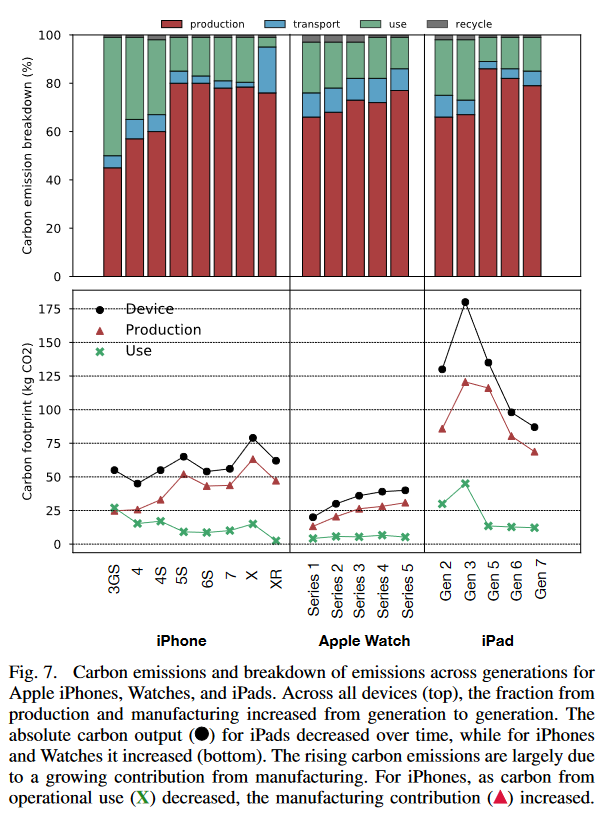
Image credit: Gupta, Udit, et al.
The image above from the 2020 review shows that the capital costs of designs remains high and is an excellent candidate for sustainability improvement. So, what does it look like to design for reduced capital environmental costs?
Gupta’s team states that increasing the complexity of a circuit can increase the amount of resources required to fabricate a chip. The desired performance, circuit components packed in, and complexity of the circuit affects how much and even what kind of resources are required in the manufacturing of the designed chip, and thus the capital costs. The research team led by Gupta also emphasizes that without changing anything about how the fab itself operates, the designer can improve sustainability. This is because the design directly affects the resources used based on it’s demands for what it takes to realize the design.
Exemplary Sustainable Design
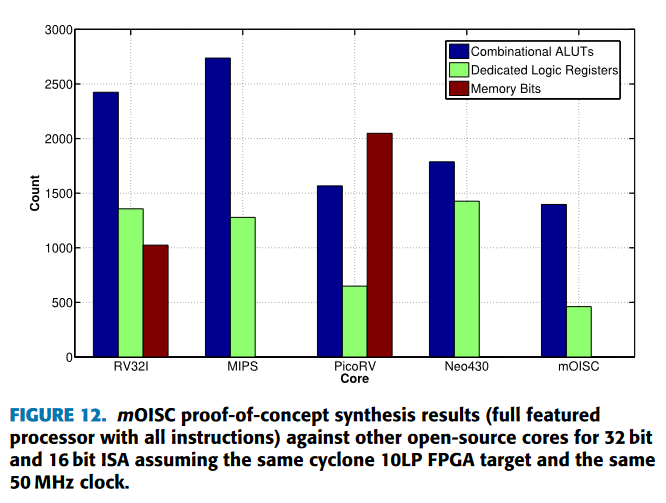
Image credit: Crepaldi, Marco, et. al.
A team of researchers from the Italian Institude of Technology led by Marco Crepaldi has designed a protoype microprocessor while minimizing both the capital and operational costs by aiming for being small and simple. Their proof-of-concept design demonstrates how a microprocessor that is fully functional may put more emphasis on the concern for both types of sustainability costs. The image above is a graph that shows how their design has fewer circuit elements than other comparable designs. They reduce the fab’s capital costs by carefully using fewer circuit components, which has the tradeoff of slightly slower computation speed, which is perfectly acceptable in certain applications, as we will see later. This design is simplified by having a “reduced instruction set”, which means that the computer does less complicated operations at a time. This kind of design is simpler and thus is less expensive to manufacture, which allows for big savings in capital expenses.
One way their design addresses the operation costs is by emphasizing their implementation of multiple hardware interrupt capabilities. A hardware interrupt is a common mechanism used in all kinds of microprocessors designs. A hardware interrupt is a way that some electrical signal that the mictrocontroller receives from other hardware can interrupt whatever the microcontroller is already working on and force it to do something else. In the case of Crepaldi’s design, placing this mechanism in the design allows a way for the device to save power when it is running. Activating one of the hardware interrupts in Crepaldi’s design tells the microprocessor to sleep until it receives an electrical signal from the outside world to wake it up. When the microcontroller is sleeping, it uses significantly less power even though it is still turned on. This allows the device to use less power while it is waiting on something to change in the outside world, much like a motion-activated light.
In the presented microcontroller design, the device can less power when it is waiting for a sensor value to change. Devices based off designs like this can be used literally in the field of a farm. Crepaldi and his team say that following this design, real-world devices used as sensors in smart agriculture, can operate reliably at ultra-low power for a long time. This works because the big thing that a smart sensor does besides actual sensing is communicating. Due to the fact that communication often involves waiting for the other party to respond, we can get massive power savings because, according to Crepaldi, “ultra-low power consumption […] is generally possible by waiting.” This is just one example of an application where performance can be traded off for sustainability.
Some devices just don’t to have the latest high-performance CPU because in their use cases they don’t need to be rapidly crunching the numbers.
A Coming Cornucopia of Simple Chips
Crepaldi’s team has presented an example design for a microcontroller that balances operational and capital expenses. This is a challenging design problem that still has so much room for innovation. It is important for the industry to continue moving in the direction of considering both these aspects of sustainable design. One last interesting point follows from the trending proliferation of smart devices. As we expect the number of smart devices to increase, leaning towards simpler designs is desirable because having smaller chips allows for more chips to be packed on that silicon wafer which chips are made from.
Bibliography
- Crepaldi, Marco, et al. “A Multi-One Instruction Set Computer for Microcontroller Applications.” IEEE ACCESS, vol. 9, 2021, pp. 113454–74. Clarivate Analytics Web of Science, https://doi.org/10.1109/ACCESS.2021.3104150.
- Gupta, Udit, et al. Chasing Carbon: The Elusive Environmental Footprint of Computing. arXiv:2011.02839, arXiv, 28 Oct. 2020. arXiv.org, https://doi.org/10.48550/arXiv.2011.02839.
- S. Andrae and T. Edler, “On global electricity usage of communication technology: trends to 2030,” Challenges, vol. 6, no. 1, pp. 117–157, 2015.
-
Sustainable.
Merriam-Webster.com Dictionary, Merriam-Webster, https://www.merriam-webster.com/dictionary/sustainable. Accessed 8 Apr. 2025.